
Donors Aren't Customers: Why Nonprofits Lose 80% of First-Time Supporters
Nonprofits lose 80% of first-time donors by using tools built for transactions, not trust. A new approach to building lasting donor relationships..

The nonprofit technology ecosystem is full of “Donor CRMs”—which is an oxymoron. Here’s what that costs us: according to the Fundraising Effectiveness Project, only about 20% of first-time donors give again.1 Nonprofits often spend more to acquire a donor than they receive in first-year revenue, with break-even typically requiring multi-year retention.2 Meanwhile, for-profits turn the same marketing spend into sustainable revenue streams. This isn’t just inefficiency—it’s a fundamental misunderstanding of what the donor relationship actually is.
The Category Error
Donors are not customers, so why do nonprofits treat them like customers? A business’s relationship with a customer is transactional, with a time horizon that depends on the type of transaction. If a business fulfills a short-term need—like providing a transitory product or service—that relationship only remains meaningful if the circumstances persist or recur.
Consider restaurants: If someone visits a neighborhood restaurant and enjoys it, they’ll likely return whenever they crave that cuisine. But if someone dines at a restaurant while traveling, returning depends on whether they’ll be back in that area AND feel inclined to eat there again. This same dynamic applies across products and services: customers have needs, businesses fulfill them.
Nonprofits operate on entirely different principles. They don’t fulfill a donor’s personal need—instead, both parties share concern about a community or societal problem and want to work together to address it. This creates a fundamentally different dynamic, one built on trust. Starting with trust, these relationships flourish through transparency, communication, and continuous feedback.
Where Traditional Tools Break Down
A donor will support a cause as long as they share concern for the problem and it remains unsolved. Their level of commitment and practical contributions may vary with their capacity to help. This is where donors must make budgeting decisions, matching their resources to the most pressing needs. But if nonprofits aren’t adequately communicating their work—sharing both challenges and achievements—donors lack the data points to make informed decisions. They default to what seems convenient or whoever shouts loudest, creating endless cycles of acquisition and attrition.
The problem compounds when you examine how traditional “Donor CRMs” actually work. They give nonprofits a 360-degree view of individual donors to tailor campaigns through email, postal mail, phone calls, or texts. Some even offer donor dashboards for managing giving history or recurring donations. But here’s the critical flaw: they serve single nonprofits. A donor supporting multiple causes must log into multiple websites to see their giving history—administrative and cognitive burden that guarantees drop-offs.
These platforms rely on email updates for engagement, creating another silo, another drop-off point. According to M+R Benchmarks, fundraising emails achieve only a 0.48% click-through rate, and donation page completion hovers around 12%—worse on mobile, where most traffic now originates.3 Despite nonprofits’ hard work stitching together multiple systems to create an apparently coherent feedback loop, donors still struggle to see their impact. Many simply disappear.
Why Even Great Websites Aren’t Enough
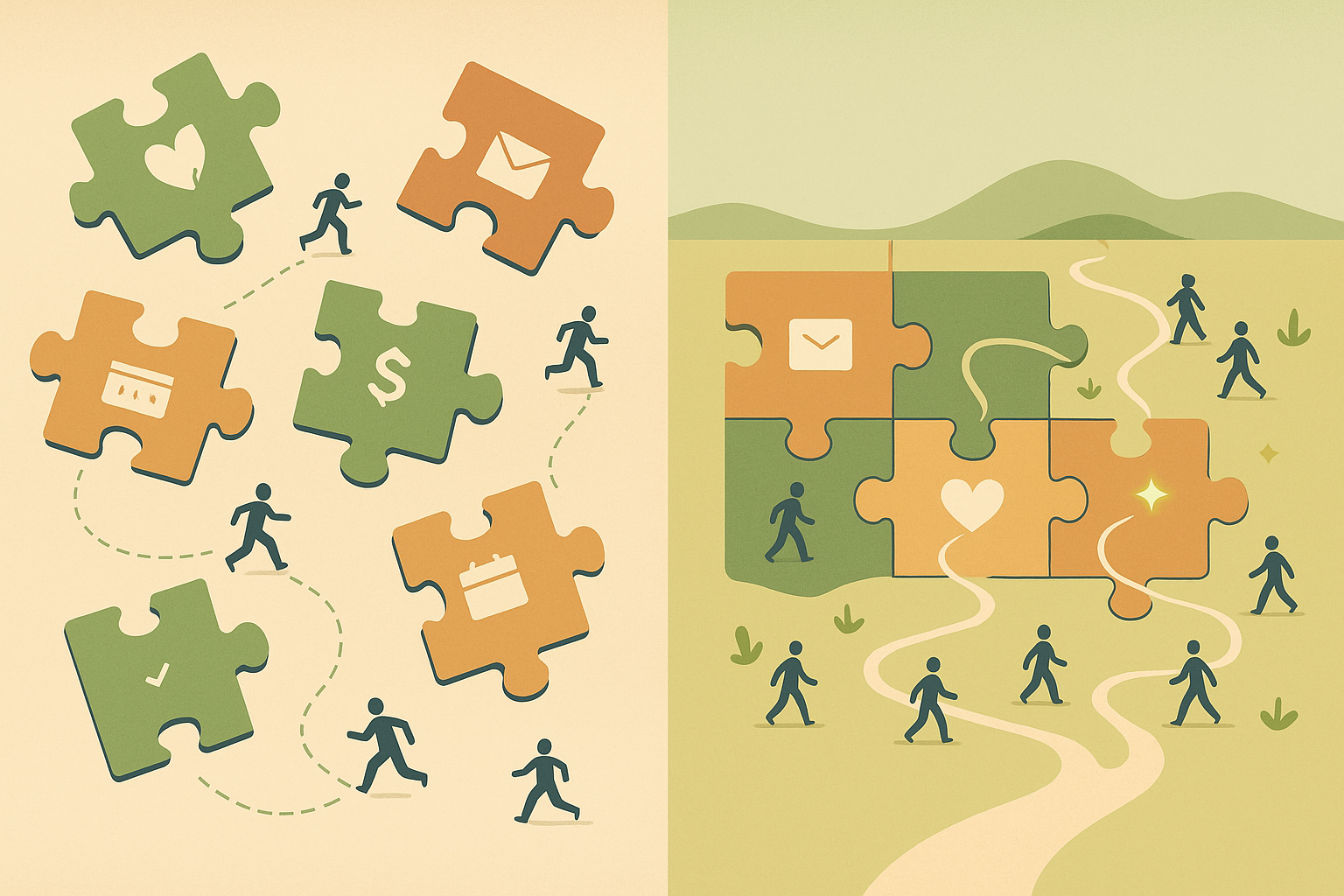
Even if a well-resourced nonprofit builds a beautiful, fast, mobile-perfect site with flawless giving UX, it only solves the problem for that one organization. Donors don’t live inside a single site; they support multiple causes. The fragmentation remains:
- Attention stays scattered: Each organization still fights to pull donors out of daily life into its separate domain
- Habits can’t form across silos: Excellence in isolation doesn’t create a routine of returning
- Friction multiplies: Multiple logins, scattered receipts, inconsistent updates, and inbox-driven follow-ups create cumulative cognitive load
The result: you can optimize your funnel to perfection and still lose the long game because the donor’s experience remains fragmented. Continuity isn’t an organization-level problem; it’s a donor-level problem.
How Gudsy Flips the Model
This systemic fragmentation is exactly why we built Gudsy on a different premise: instead of forcing nonprofits to compete in the general attention economy, we create a dedicated giving ecosystem where trust and transparency compound naturally.
When donors use Gudsy for all their giving—donations, volunteering, workplace giving—they naturally return to the platform. Even when individual nonprofits reach out, it drives donors back to Gudsy, where they see their entire giving landscape: their donor dashboard shows complete giving history across all causes, downloadable receipts, recurring donation management, and critically, a news feed with updates from every nonprofit they support.
This persistent engagement creates what traditional CRMs can’t: genuine community building through transparency. Each nonprofit gets a persistent digital address—their Gudsy profile—that serves as a living source of community outreach. People discover these profiles through geographic proximity, keyword search, public search engines, and more. The transparency and frequent information sharing that builds trust isn’t scattered across channels competing for attention—it’s centralized where donors already manage their giving.
The Three Pillars
Easy: One donor home for complete giving history, receipts, recurring donation controls, and updates across all supported causes—no juggling multiple portals.
Organic: Every nonprofit has a discoverable public profile. Community grows through geographic discovery, search, and natural sharing—not aggressive acquisition campaigns.
Reliable: Privacy-first design, nonprofit-controlled data, and transparent pricing that lets organizations keep more of what they raise.
The Bottom Line
We go to online banking to pay bills, Amazon to shop, Netflix to watch. I want Gudsy to become the natural association with giving back. When more nonprofits join this community, that vision becomes reality. This is why I’ve designed the platform and pricing with low barriers to entry—to fundamentally change how nonprofits build communities and how communities give back.
The math is simple: when donors have one place to manage all their giving, and nonprofits have one place to build genuine community, the cycles of acquisition and attrition break. Trust replaces transactions. Community replaces customers. And giving becomes as natural as any other part of our digital lives.