
GPS for Social Good: Why Nonprofits Need Real-Time Navigation
GPS doesn't just tell us where to go—it warns us about traffic, accidents, and detours. Nonprofits navigating a shifting landscape of funding cuts, legislative changes, and emerging community needs deserve the same capability. Here's the thinking behind Gudsy's registered trademark and an invitation to explore what real-time navigation could mean for your mission.

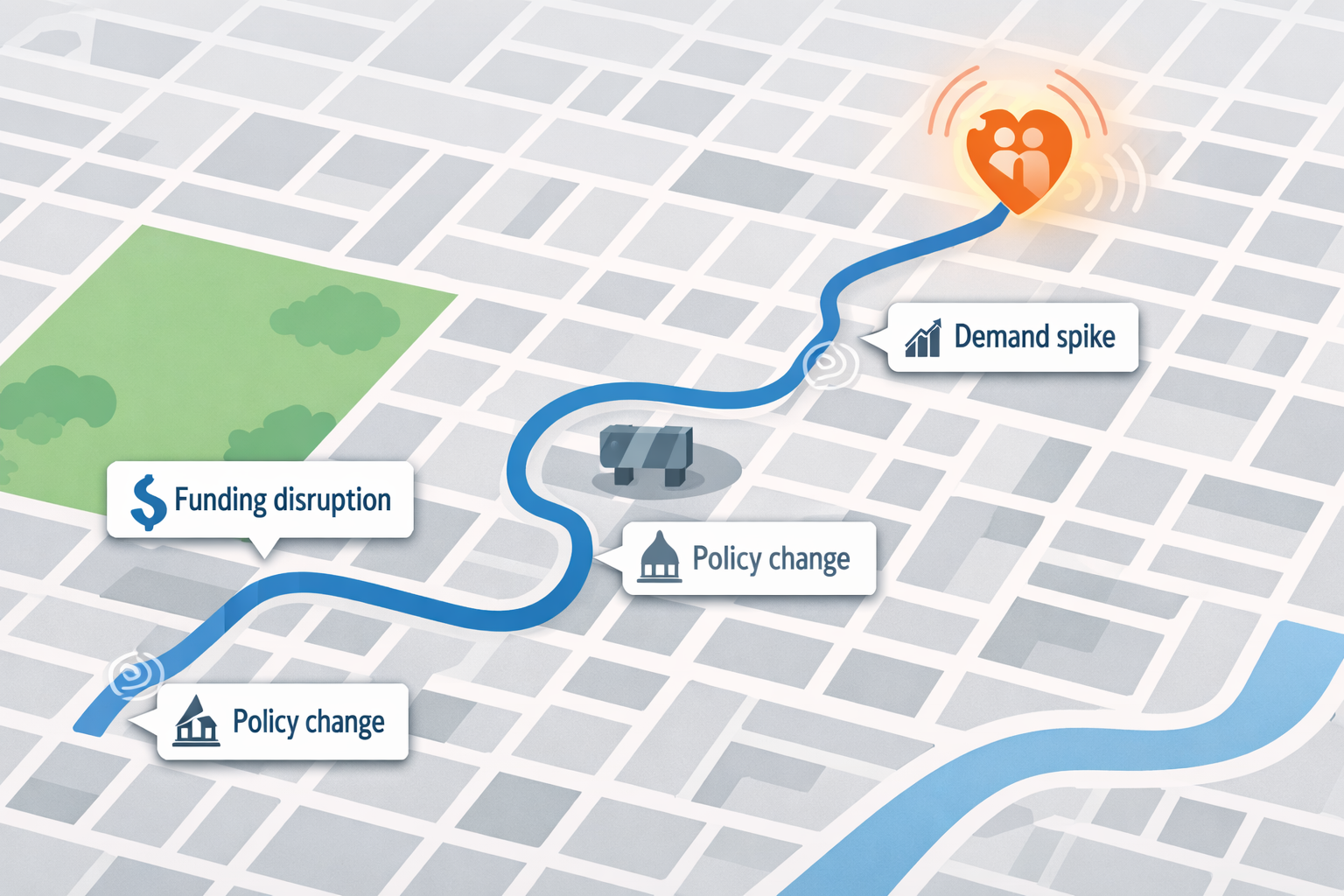
Most of us use GPS daily without thinking much about it. We punch in a destination and trust the system to get us there. But navigation apps do far more than route planning—they monitor real-time conditions, warn us about accidents ahead, suggest detours around construction, and adjust when circumstances change.
Here’s what we’ve been thinking about: nonprofits navigate terrain that shifts just as constantly as highway traffic. And they deserve the same kind of real-time awareness.
The landscape keeps moving
The past year alone has seen extraordinary turbulence for organizations trying to serve their communities. A third of nonprofits experienced federal, state, or local government funding disruptions in early 2025.[1] Budget proposals have pulled back domestic programs tied to housing, education, workforce development, and public health.[2] The longest government shutdown in U.S. history began in October 2025, compounding pressure on an already stretched sector.[3]
Legislative goal posts don’t stay fixed. Funding sources shift. Community needs evolve in response to forces no single organization controls.
Yet most nonprofits still communicate with supporters the way they did a decade ago: periodic newsletters, annual appeals, and campaign-specific asks. Static communication in a dynamic environment.
What GPS actually does
Think about what makes navigation apps valuable. They don’t just store a map—they continuously synthesize data streams: traffic flow, reported incidents, road closures, even weather patterns. When conditions change, routes update. When a new hazard appears, drivers get alerted.
The metaphor breaks down if we think of GPS as merely giving directions. Its real value lies in keeping you informed about changing conditions between you and your destination.
The communication gap
Nonprofits on the front lines know when needs shift—when a new family arrives at the shelter, when the food bank sees a sudden spike in demand, when legislative changes alter who qualifies for services. They experience these shifts in real time.
But their supporters? They find out weeks or months later, if at all. The connection between emerging needs and available help travels through bottlenecks: social media algorithms determine who sees what, and the cognitive load of managing multiple causes means even caring supporters lose track.
This gap isn’t a failure of intention on either side. It’s a structural problem—and the math compounds it. Nonprofits sent an average of 62 email messages per subscriber in 2024, yet email campaigns accounted for just 11% of all online revenue, down from 14% the previous year.[4]
GPS for Social Good
We registered GPS for Social Good® as Gudsy’s trademark because it captures something we believe matters: the organizations leading the charge on homelessness, hunger, education, environmental protection, and community health shouldn’t have to broadcast into the void and hope someone’s paying attention.
When a nonprofit claims their profile on Gudsy, they gain the ability to communicate emerging needs, opportunities, and shifting priorities through a continuous stream that reaches supporters who’ve chosen to tune in. Not as interruptions competing in a crowded inbox, but as updates within a dashboard supporters check because multiple causes they care about surface there together.
The goal is navigation infrastructure for the social good sector—a way for nonprofits to signal when conditions change and for communities to respond.
The network effects
There’s a compounding dynamic here worth naming. Gudsy indexes 1.8 million U.S. nonprofits with semantic and geographic discovery built in. When supporters search for causes—by location, by issue area, by mission keywords—the platform surfaces organizations that might otherwise never break through algorithmic noise.
When a nonprofit claims their profile, they don’t just gain communication tools. They tap into discovery pathways where supporters actively seek causes to support. They can receive donations and volunteer sign-ups directly. And as more organizations and supporters join, the network effects benefit everyone—each addition makes the platform more valuable for discovery, engagement, and sustained connection.
The honest acknowledgment
We believe this approach addresses a structural gap. We don’t yet have longitudinal data proving it transforms retention rates. That’s precisely why we’re looking for partners willing to test the hypothesis alongside us.
Invitation: Free 3-month pilot
If this resonates—if you’re tired of broadcasting into the void while conditions shift beneath your feet—we’re inviting nonprofits to a free 3-month pilot.
Claim your profile. Gain access to real-time communication tools. Discover what it feels like to have navigation infrastructure designed for the terrain you actually traverse.
Let’s find out together whether GPS for Social Good can help your mission reach its destination.
References
[1] Urban Institute — “How Government Funding Disruptions Affected Nonprofits in Early 2025” https://www.urban.org/research/publication/how-government-funding-disruptions-affected-nonprofits-early-2025
[2] Foundation List — “Nonprofit Funding Trends 2025: Tariffs, Job Cuts, and Donor Shifts” https://www.foundationlist.org/nonprofit-funding-trends-2025/
[3] The Nonprofit Alliance — “2025 Nonprofit Policy Moments and a 2026 Look Ahead” https://tnpa.org/2025-nonprofit-policy-moments-and-a-2026-look-ahead/
[4] M+R Benchmarks 2025 Study — Email Messaging Metrics https://mrbenchmarks.com/charts/email-messaging