
The Dual Fragmentation Tax Nonprofits Pay Without Knowing
Most nonprofits are paying a hidden tax—not to the IRS, but to a fragmented ecosystem of disconnected tools and overwhelmed supporters. We call it dual fragmentation. Here's how it works, what it costs, and an invitation to break the cycle.

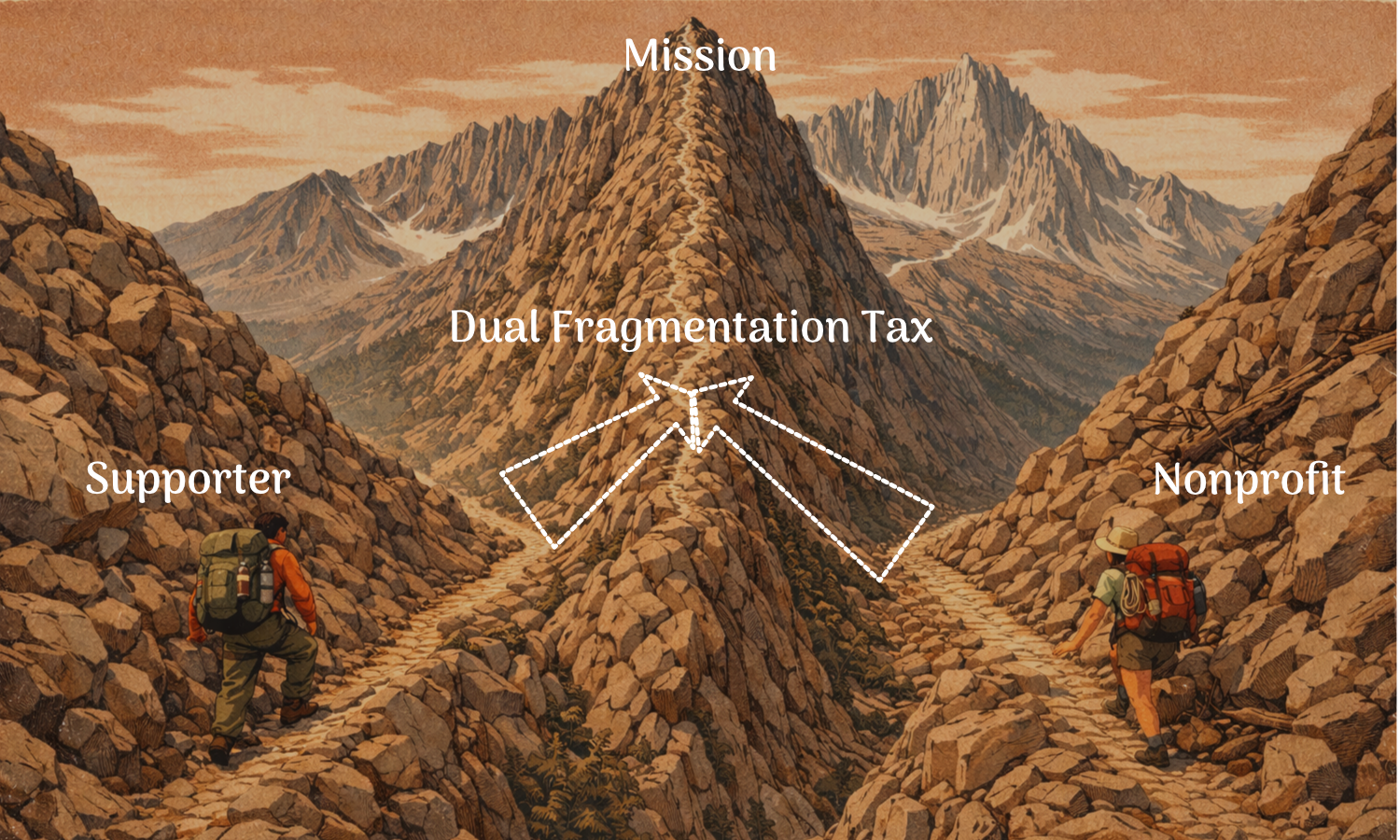
Most nonprofits are paying a tax they’ve never seen on a balance sheet. It doesn’t show up as a line item. No invoice arrives. But it quietly drains resources from both sides of the giving relationship.
We call it the dual fragmentation tax.
Here’s how it works
On the nonprofit side: organizations cobble together disconnected tools—one platform for email outreach, another for donation forms, a separate system for volunteer management, yet another for event registration, plus social media scheduling tools. Each operates in isolation. Each requires its own login, its own learning curve, its own subscription fee. Keeping these systems consistent demands heroic coordination and ongoing costs.
On the supporter side: every cause they care about brings its own emails, its own portal, its own account credentials, its own asks—all competing for attention in an inbox already overflowing with 117+ messages daily.[1] Each nonprofit fights alone for a sliver of attention in the same crowded space.
The result is a vicious cycle where nonprofits exhaust resources managing fragmentation while supporters disengage from the cognitive overload.
The math is unforgiving
The sector’s donor retention rate sits at 42.9%—meaning 57% of donors don’t return the following year.[2] For first-time donors, the numbers are starker: only about 1 in 5 gives again.[2] That’s an 80% attrition rate for new supporters.
Here’s where it compounds: acquiring a new donor typically takes 18-24 months of continued giving to break even on acquisition costs.[3] When 4 out of 5 new donors never make a second gift, most acquisition investment evaporates before it can pay off.
As researcher Adrian Sargeant has documented, a 10% improvement in donor retention can increase the lifetime value of a donor base by 200%.[4] Yet most organizations invest heavily in acquisition machinery while investing almost nothing in keeping supporters once they arrive.
A father with two kids in elementary school
I recently spoke with a parent running a small business while raising two children in elementary school. He mentioned he doesn’t get involved with the school PTA—not because he doesn’t care, but because he’s already overwhelmed.
Between both children, he receives a constant stream of emails from teachers, school administrators, after-school programs, and parent groups. The information load is already more than he can process while running his business and focusing on his kids.
The PTA’s outreach simply becomes part of the noise. Another email. Another ask. Another thing he means to get to but never does.
This is how engaged, caring people become non-participants. Not through apathy—through overload.
The downstream effects
When potential supporters disengage, nonprofits feel it directly. PTAs run deficits. Community organizations can’t fill volunteer slots. Food banks operate with skeleton crews. The missions that depend on broad participation suffer—not because people stopped caring, but because the systems that connect them create too much friction.
Each nonprofit responds by sending more emails, adding more platforms, creating more accounts for supporters to manage. The fragmentation deepens on both sides.
Breaking the cycle
We built Gudsy around a different structural assumption: what if we reduced fragmentation on both sides simultaneously?
For nonprofits: One unified platform for donations, volunteering, events, and ongoing engagement—eliminating the patchwork of disconnected tools and the costs of managing them.
For supporters: One dashboard where all the causes they care about surface together. One calendar that integrates volunteer opportunities, events, and giving days into their existing routines—not as interruptions, but as part of life’s rhythm.
When a supporter checks their Gudsy dashboard because one organization sent a reminder, they also see updates from the other causes they follow. The food bank’s volunteer shift. The school fundraiser. The community cleanup. Engagement compounds rather than competes.
The honest acknowledgment
We believe this structural change improves the odds. We don’t yet have years of published benchmarks to prove it. That’s precisely why we need partners willing to test the hypothesis in their own contexts.
Invitation: Free 3-month pilot
If this resonates—if you’re tired of paying the fragmentation tax on both sides—we’re inviting nonprofits to a free 3-month pilot.
No integration headaches. No patchwork of tools. Just one platform designed to free up your operational costs while lowering the cognitive burden on the supporters you’re trying to reach.
Let’s find out together whether a unified approach can break the cycle.
References
[1] Microsoft WorkLab — “Breaking down the infinite workday” https://www.microsoft.com/en-us/worklab/work-trend-index/breaking-down-infinite-workday
[2] Fundraising Effectiveness Project — “FEP 2024 Quarterly Benchmark Report (Q4 2024)” https://publications.fepreports.org/archive/usa/2024/q4/
[3] TrueSense Marketing — “Long-Term Value Is a Fundraiser’s Most Important Metric” https://www.truesense.com/blog/long-term-donor-value-is-a-fundraisers-most-important-metric.-heres-why
[4] Adrian Sargeant — Interview on Donor Retention and Sustainability https://www.amyeisenstein.com/dr-adrian-sargeant-donor-retention-sustainability-training/