

Why Gudsy Matters: Two Years In
Two years ago I wrote about why Gudsy matters. I had the intuition but not the data. Now, with 57% annual donor attrition and declining retention, I can name the problem more precisely.

Nearly two years ago, I wrote about why Gudsy matters. I knew something was broken in how nonprofits and supporters connect, but I couldn’t articulate it precisely. I had intuition—the sector felt fragmented, donors seemed scattered, sustained support felt harder than it should be.
Two years of building, listening, and studying the data have sharpened that intuition into something I can now name more clearly.
The numbers behind the intuition
Nonprofits do essential work—filling gaps that governments and markets leave open. But here’s the uncomfortable part I suspected but couldn’t prove back then: the systems nonprofits rely on are quietly working against them.
According to the Fundraising Effectiveness Project, overall donor retention sits at 42.9%—meaning 57% of last year’s donors won’t give again this year. For first-time donors, only about 1 in 5 returns.1 This has been declining for five consecutive years.
Meanwhile, reaching those donors is getting harder. The average nonprofit fundraising email achieves a 0.48% click-through rate. Among those who do click, only 12% complete a donation.2
These aren’t failures of effort. Nonprofits work hard. The problem is structural.
The fragmentation tax
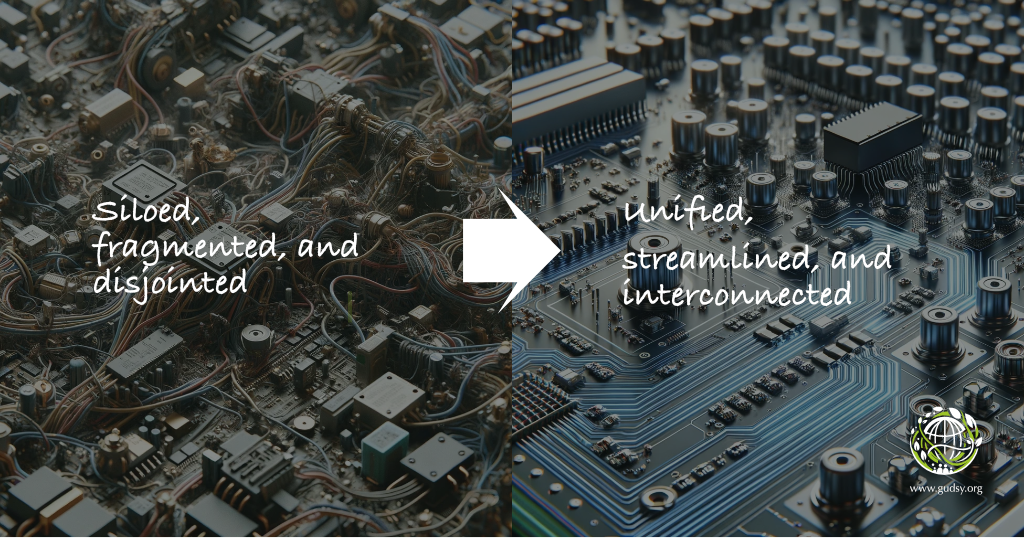
There’s an issue that rarely gets named directly: both nonprofits and their supporters pay a hidden cost we might call the fragmentation tax.
On the nonprofit side: organizations juggle disconnected tools—one for email, another for donations, another for events, another for volunteers. Each system generates its own data silo. Coordination is manual and exhausting.
On the supporter side: people who care about multiple causes navigate a maze of separate logins, scattered emails, disconnected receipts, and competing asks. Every organization fights alone for attention in the same crowded inbox.
The result: good intentions get lost in the noise. Sustained relationships depend on luck more than design.
A local volunteer’s week
Consider someone who volunteers at their kids’ school, donates to their place of worship, supports a neighborhood food bank, and gives to an environmental organization.
That’s four causes—each with its own website, its own email list, its own login, its own way of tracking involvement. The school PTA sends reminders through one app. The food bank uses a different volunteer scheduling system. The environmental org tracks donations somewhere else entirely. Year-end tax receipts arrive in four different formats, if they arrive at all.
When life gets busy—and it always does—staying engaged with all four requires remembering four different systems, four different passwords, four different communication streams buried in an inbox already overflowing with everything else.
Most people don’t maintain all four relationships. Not because they stopped caring, but because the friction accumulates quietly until engagement feels like work rather than purpose.
Now multiply that across a community. The fragmentation tax isn’t paid once—it compounds with every cause someone tries to support.
From intuition to hypothesis
Back in 2024, I wrote about putting donors and volunteers “at the center.” That instinct was right, but I didn’t have the framework to explain why it mattered structurally. Now I do.
We built Gudsy around a specific question: what if we reduced fragmentation on both sides?
For supporters, that means one place to manage all their giving—donations, volunteer hours, workplace matching—across every cause they care about. One dashboard. One set of receipts. Updates from all their organizations in a single feed. When giving is organized rather than scattered, it stops feeling like administrative burden and starts feeling like a natural part of life.
For nonprofits, it means reaching supporters in an environment designed for sustained engagement rather than one-time transactions. When a supporter logs in because one nonprofit sent an update, they see activity from all the causes they follow. The PTA reminder surfaces alongside the food bank’s volunteer signup and the environmental org’s campaign update. Return behavior builds naturally because the platform rewards coming back.
Here’s what changes structurally: instead of every nonprofit competing alone in crowded inboxes, they benefit from a shared ecosystem where engagement with one organization reinforces engagement with others. The math shifts from isolated low-probability asks to compounding return visits.
We don’t yet know exactly how much this changes the underlying numbers. The structural logic suggests it should help—reducing friction, increasing visibility, building habits. But we’re not asking anyone to take our word for it.
An invitation
If you’re a nonprofit leader tired of fighting for attention in crowded inboxes, or a supporter who wants giving to feel less scattered, we’d like to explore this together.
We’re offering free pilots for nonprofits willing to help us measure whether a different design actually improves retention and engagement. We’ll track return frequency, actions taken, and repeat engagement over 90 days—real data from your community, not hypotheticals.
The goal isn’t to prove we’re right. It’s to find out what works, and to build something genuinely useful for the sector.
If this resonates, let’s talk. We’re not asking you to believe our hypothesis—we’re asking you to help us test it.
References
Footnotes
-
Fundraising Effectiveness Project — “FEP 2024 Quarterly Benchmark Report (Q4 2024)” https://publications.fepreports.org/archive/usa/2024/q4/ ↩
-
M+R Benchmarks — “Email Messaging – Benchmarks 2025” https://mrbenchmarks.com/charts/email-messaging ↩