
Your Donors Care. The Math Doesn't.
What if sustained support didn't depend on inbox luck? We ran the numbers on what it actually takes for a fundraising email to turn into a completed gift. The math is humbling. This article is our attempt to name a structural problem—and an invitation to help us test whether a different design can improve the odds.

Digital noise is rising. Attention is shrinking. And nonprofits still need sustained support to serve real people in real communities.
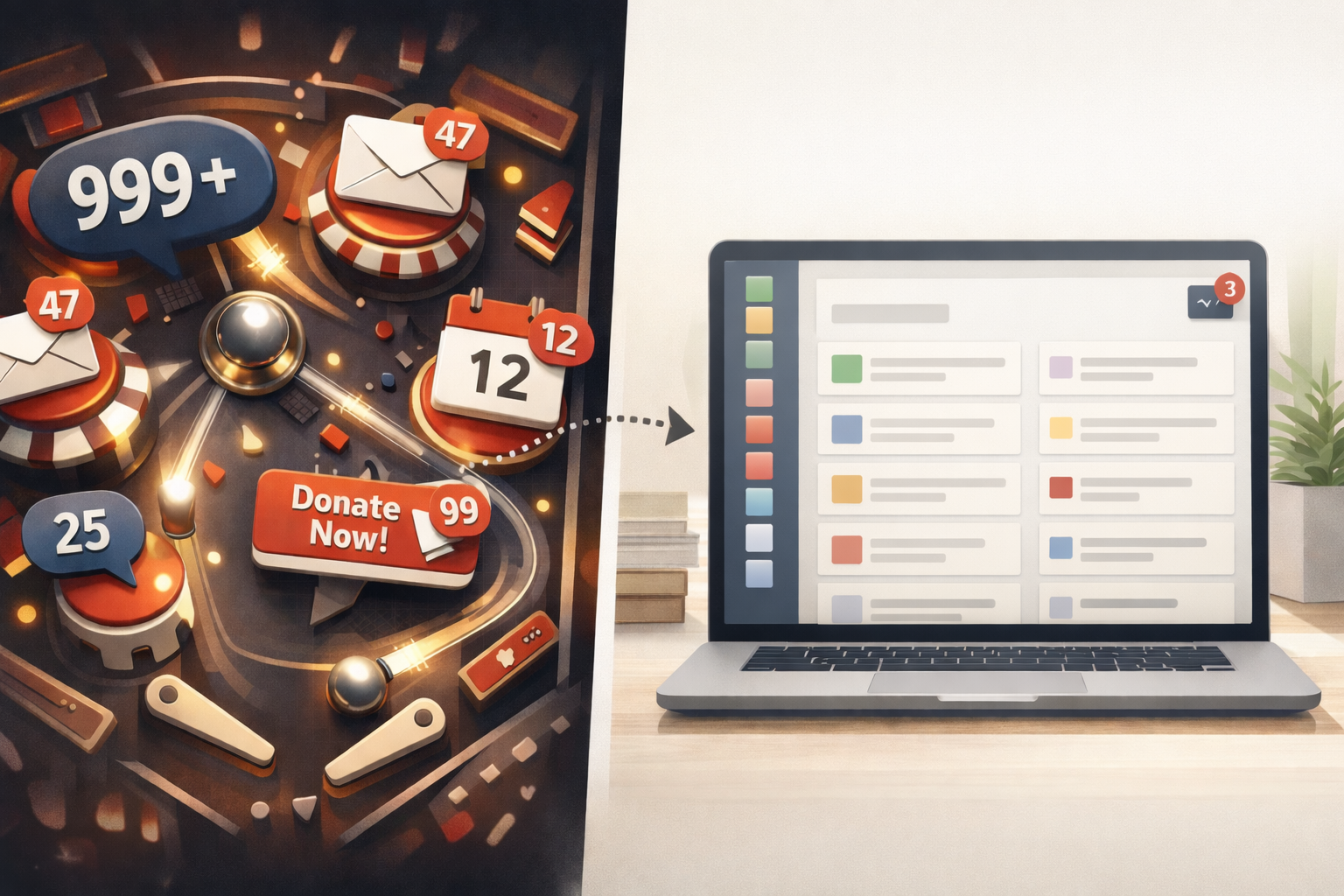
Here’s the uncomfortable part: when support depends on crowded inboxes, busy feeds, and scattered logins, it can start to feel like pinball—not because people don’t care, but because the underlying math is unforgiving.
The baseline odds are already difficult
Most of us operate inside a constant interruption stream. The average worker receives 117 emails per day.[1] Americans exchanged over 2.1 trillion texts in 2023.[2]
Meanwhile, nonprofit donor retention sits at 42.9%—meaning 57% of donors don’t return the following year. For new donors, only about 1 in 5 gives again.[3] And donor acquisition typically takes 12–18 months to become profitable.[5]
When sustained support depends on winning attention inside this environment, the economics become fragile.
The dual fragmentation problem
There’s a structural issue that rarely gets named directly.
On one side: nonprofits use disconnected tools—one for email, another for events, another for donations, another for volunteers. Each system operates in isolation.
On the other side: supporters juggle disconnected relationships. Every cause has its own emails, its own links, its own logins, its own reminders.
We call this dual fragmentation. Each nonprofit fights alone for attention in the same crowded inbox. Each supporter manages a scattered portfolio of good intentions with no shared infrastructure.
The result: sustained relationships get left to chance.
A busy family with 3 kids across 3 schools
Picture a household with children in elementary, middle, and high school.
Each school has its own PTA or PTO—that’s 3 separate organizations. Add booster clubs for band, athletics, drama. Their place of worship. A couple of neighborhood nonprofits. A community org tied to sports or mutual aid.
That’s easily 10+ causes. Each with its own emails, texts, donation platforms, volunteer signups, and event calendars.
Now here’s the math we keep returning to.
Assume each cause sends one fundraising email per month. Over 90 days, that’s 30+ fundraising emails landing in a household inbox already receiving 100+ messages daily.
Using M+R Benchmarks data: the average fundraising email click-through rate is 0.48%, and donation page completion among those who click is 12%.[4]
That implies roughly a 0.058% probability that any single fundraising email results in a completed gift.
Even with 30 emails over 90 days, the probability that at least one converts to a completed gift is only about 1.7%.
That’s the pinball math.
Not because the family doesn’t care. Because the system fragments their attention across causes while each cause competes alone.
Our design hypothesis
We built Gudsy around a different assumption: what if we reduced fragmentation on both sides?
For supporters:
- One login across all the causes they care about
- One dashboard where updates from multiple nonprofits surface together
- One calendar where actionable opportunities—events, volunteer shifts, giving days—become part of weekly rituals instead of inbox accidents
For nonprofits:
- When a supporter logs in because your email prompted them, they also see updates from other causes they follow—and more importantly, they’re now in the habit of returning
- The platform builds return behavior, not just click behavior
Here’s what changes structurally.
In the interrupt model, each email is an independent low-probability event. Every cause competes alone.
In a return model, one trigger can surface multiple opportunities. When a family checks their dashboard because the PTA sent a reminder, they also see the food bank’s volunteer signup and the church’s upcoming fundraiser. Calendar integration means engagement rides on existing habits rather than requiring new ones.
We don’t yet have published benchmarks for return-model platforms. But the structural math suggests that consolidation—reducing friction, increasing visibility across causes, building return habits—should meaningfully improve the odds versus interrupt-driven baselines.
The honest version: we believe this changes the odds. We need partners to help us find out.
Invitation: 3-month pilots
If you’re a nonprofit and this resonates, we’re inviting you to a free 3-month pilot.
The pilot’s purpose is to turn our hypothesis into evidence—in your context—by measuring:
- Supporter return frequency
- Actions taken (donations, RSVPs, volunteer signups)
- Time-to-next-action
- Repeat engagement within 90 days
We’re not asking you to believe our math. We’re asking you to help us test it.
If you’re tired of sustained support feeling like pinball, let’s find out together whether a different design improves the odds.
References
[1] Microsoft WorkLab — “Breaking down the infinite workday” https://www.microsoft.com/en-us/worklab/work-trend-index/breaking-down-infinite-workday
[2] CTIA — “2024 Annual Survey Highlights” https://www.ctia.org/news/2024-annual-survey-highlights
[3] Fundraising Effectiveness Project — “FEP 2024 Quarterly Benchmark Report (Q4 2024)” https://publications.fepreports.org/archive/usa/2024/q4/
[4] M+R Benchmarks — “Email Messaging – Benchmarks 2025” https://mrbenchmarks.com/charts/email-messaging
[5] Adrian Sargeant (2007) — “Donor retention: What do we know and what can we do about it?” https://charitablegiftplanners.org/sites/default/files/sargeant-donor-retention-what-do-we-know-and-what-can-we-do-about-it.pdf